
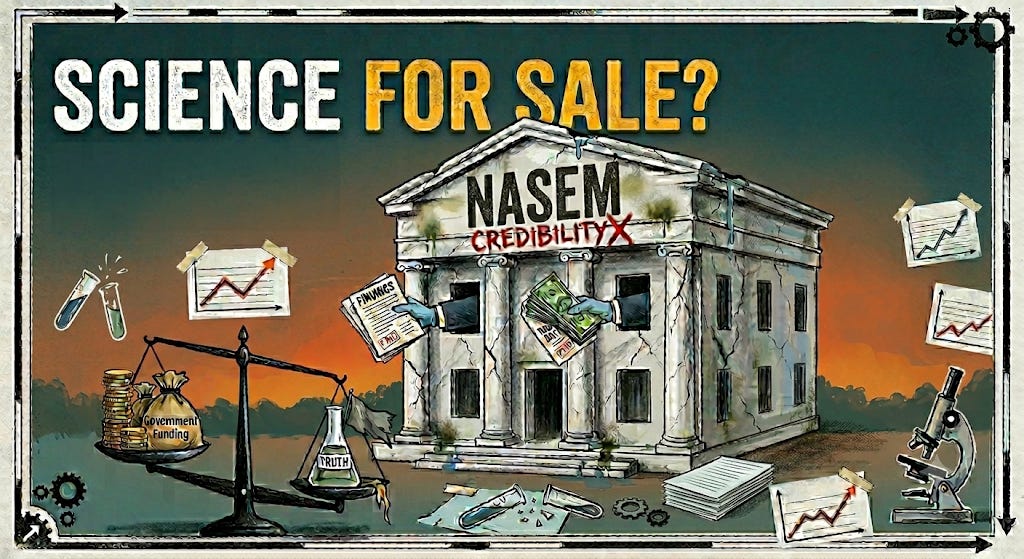
Science for Sale?
The federally funded institution meant to give America independent scientific guidance has a credibility problem.

The National Academies of Sciences, Engineering, and Medicine (NASEM) was founded by Abraham Lincoln in 1863 to provide the U.S. government with independent, nonpartisan scientific guidance. One hundred and sixty years later, a string of watchdog groups, state attorneys general, and lawmakers are raising questions about whether the institution is still doing that, and a fight over a single chapter in a federal judges’ reference manual has pushed those questions into the nation’s courtrooms.
What Is NASEM?
NASEM is a congressionally chartered private nonprofit that does not receive direct appropriations from Congress, but is heavily subsidized through federal contracts and grants. According to its 2024 tax filings, over 56% of its revenues, more than $205 million, came from government funding. In the final fiscal year of the Biden administration, the Department of Transportation alone directed $84 million in taxpayer funds to the Academies.
The Federal Judicial Center Controversy
On December 31, 2025, the Federal Judicial Center, the research arm of the federal judiciary, released the fourth edition of its Reference Manual on Scientific Evidence, a roughly 1,600-page guide judges rely on to weigh complex expert testimony. Produced in partnership with NASEM, the new edition included, for the first time, a dedicated chapter on climate science. The chapter leaned heavily on attribution science, a novel and contested field that claims to link specific climate damages to specific human activities — the precise theory plaintiffs are advancing in climate lawsuits against the U.S. energy industry.
Legal experts and Republican attorneys general quickly raised alarm. The chapter’s lead author, Columbia University’s Jessica Wentz, had served as a witness for plaintiffs in a climate lawsuit against the federal government and signed an amicus brief supporting Obama-era EPA regulations; she is also a top expert at the Environmental Law Institute’s Climate Judiciary Project, which the House Judiciary Committee is investigating for alleged efforts to predispose federal judges toward climate plaintiffs in active litigation. Worse still, Wentz and her coauthor credit the work of their frequent collaborator Michael Burger. Burger serves as Of Counsel for Sher Edling, the principal law firm driving the climate litigation, including more than two dozen blue state and municipal lawsuits, which stands to gain hundreds of millions to billions of dollars in contingency fees from these cases.
A coalition of 27 Republican state attorneys general wrote to the FJC on January 29, 2026, demanding the chapter’s immediate withdrawal and warning it would tip the scales toward plaintiffs in active climate litigation. Eight days later, the FJC pulled it. The full chapter, bearing FJC branding, nonetheless remains available on NASEM’s website, which has publicly stood by it.
The fight has only escalated this month. In a letter to FJC Director Robin Rosenberg, a coalition of more than two dozen Democratic attorneys general and city legal officers is now pressing the center to reinstate the chapter, arguing its removal leaves judges and litigants “without impartial, peer-reviewed information” on complex scientific questions. What the letter omits, is that many signatories are themselves plaintiffs in the very climate cases the chapter would touch. Hawaii’s Anne Lopez signed while her state pursues a suit against ExxonMobil, Chevron, and five other oil companies. Similarly, New York’s Letitia James signed as her state prepares to collect on a $75 billion “polluter pays” climate superfund. Nearly every jurisdiction behind the letter, among them California, Minnesota, Hawaii, Colorado, and the city of Chicago, has an active climate change case.
A second front opened this past week over who helped write the chapter. The Patriots Foundation, a watchdog group, filed complaints after the Universities of Arizona and Illinois refused to release public records on two professors involved in the developing the Reference Manual. The foundation’s lawyers say the universities’ near-identical refusals, paired with a NASEM general counsel’s guidance to committee members on handling records requests, suggest a coordinated effort to keep the chapter’s origins out of view.
What Critics Are Saying
Last week, the American Parents Coalition sent a letter to Congressman Brian Babin, chairman of the House Committee on Science, Space, and Technology, urging a formal investigation into NASEM’s funding and activities. The letter argues the institution has used hundreds of millions in public dollars to advance political agendas, like climate alarmism and gender ideology, in K–12 classrooms rather than its stated STEM mission.
A separate report from the American Energy Institute documents that NASEM, in addition to significant federal funding, drew in millions from leftwing climate organizations and dark money groups, many of which are the same organizations funding and supporting the climate litigation.
The Congressional Response
In May, eleven Republican lawmakers wrote to Transportation Secretary Sean Duffy and OMB Director Russ Vought asking them to consider suspending federal grants to NASEM, citing the FJC episode as evidence of broader institutional bias and undisclosed conflicts of interest. OMB Director Vought’s response: “On it.”
The Core Question
At the center of these disputes is a straightforward institutional question: Can an organization that receives the majority of its funding from the federal government, directs grants to advocacy organizations, and holds stated positions on contested policy questions credibly claim to offer independent scientific guidance?
That question is now formally before Congress.