


Election year headlines are once again dominated by familiar, high-stakes rhetoric about health care reform. An Axios report recently highlighted how health care is again becoming a central battlefield in the coming election cycle.
Years after implementation of the Affordable Care Act (ACA), the promise of “affordable” care has largely evaporated. For the average American worker, the reality is grim: health insurance premiums are rising at triple the rate of wage growth, while employers are increasingly forced to choose between offering competitive salaries and providing basic health benefits, according to HR Dive.
The Affordable Care Act’s overhaul of the individual market took effect in 2014, raising year-one premiums by 49% compared to pre-ACA individual plans. Marketplace premiums have continued to climb since then - the monthly cost of a benchmark Silver plan rose from $232 in 2013 to $625 in 2026, representing nearly a threefold increase, according to analysis by Forbes.
Why, despite decades of legislative “fixes,” are costs still on the rise?

The “Black Box” Economy
The primary reason costs continue to spiral is that the American health care system operates as a massive, opaque “black box.”
Consider the federal hospital price-transparency mandate. It was designed to let patients shop for care and create downward pressure on costs. Yet, as PatientRightsAdvocate.org reports, many hospitals are still out of compliance with the federal law. When institutions can conceal their prices, they have little incentive to become more efficient. The result is a system in which consumers are often the last people to learn what a procedure will cost, after the bill arrives.
The 340B Profiteering Machine
Perhaps the most egregious example of this lack of transparency is the 340B Drug Pricing Program. Created in 1992 as a lifeline for safety-net hospitals serving low-income patients, the program has evolved into a multibillion-dollar profit center.
Large health systems can purchase drugs at steep discounts - often 20% to 50% below list price, or even more according to - then bill insurers or government payers at rates closer to full price. They pocket the difference, which can result in a markup of 1,000% [CB1] [CB2] over acquisition cost. Federal law does not require these savings to be passed directly to patients or reported in detail.
When the Trump administration attempted to implement a pilot program[CB3] intended to create a paper trail and verify that discounts were reaching vulnerable patients, the effort faced lawsuits and lobbying opposition and was ultimately blocked in court. A program created to help people in need should be able to demonstrate that it is doing so. If it resists basic documentation and accountability, it deserves, at minimum, a serious overhaul.
The Cost of Inefficiency
The Manhattan Institute has warned that health care is on a trajectory to bankrupt the nation. The United States has created a regulatory environment that often rewards administrative bloat and waste rather than clinical outcomes. According to research published by the NIH’s National Library of Medicine, the country’s complex regulatory framework is a major contributor to the inefficiencies that make U.S. health care the most expensive in the world.
For the average employee, this shows up as a salary trade-off. Companies must divert more of their payroll budgets simply to keep pace with soaring health-plan premiums. In effect, money is being taken from American workers’ paychecks to sustain a system that often refuses to disclose its own prices.
The Inflation Reduction Act Price Controls Backfired
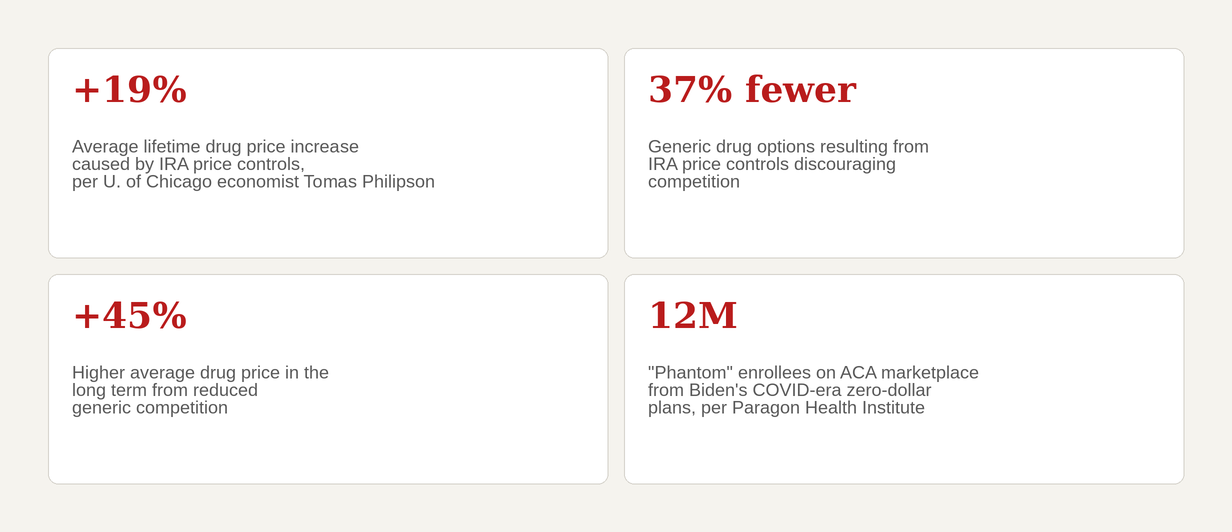
Unfortunately, recent attempts to patch this system’s flaws are backfiring. University of Chicago economist Tomas Philipson published a recent study showing that the Inflation Reduction Act’s attempts at price-controlling major drugs are causing average lifetime prices to skyrocket by 19%. As Sally Pipes argued in Forbes, the legislation’s price controls curb the revenue of newly launched drugs prior to becoming available for generics, which discourages competition. This results in 37% less generic options and a 45% higher average price in the long term.
The Senate Ways and Means Committee warned about the IRA’s negative outcomes in a 2022 report, arguing it would “derail and destroy current and future drug development, [and result] in fewer cures and reduced innovation.”
Rampant Fraud and Waste
When the government isn’t merely trying to badly fix healthcare, it’s looking the other way on abuse. Lack of enforcement on autism services ($45.6 billion), hospice care ($6.5 billion), and durable devices (40% increase in supply bills) has resulted in at least $230 billion in fraud being uncovered, including rampant fraud amongst migrant communities.
Paragon Health Institute has similarly warned that Biden’s COVID-era taxpayer-funded zero-dollar plans on the ACA marketplace have resulted in 12 million “phantom” enrollees at the cost of “billions of dollars in taxpayer funds.”
The Path Forward
“Fixing” America’s health care system requires transparency, enforceable standards, and a renewed focus on patients.
Hospitals should have to show their work on pricing. The 340B program should have to prove that it serves vulnerable patients rather than institutional bottom lines. And policymakers should prioritize a market that gives patients meaningful information and real purchasing power. Fraudsters need to be held accountable. And, yes, we need less government and more free market principles injected into the system - health savings accounts are one of the bright spots in American health care. Solutions need to be serious.
A telling tale for y'all: I'm on Medicare with a Humana Advantage option. Recently I needed a CT scan. The provider quoted a copay of $150 if we submitted the claim to Medicare. The provider also offered me the "cash discount price" of $110 if I paid out-of-pocket and no Medicare claim was submitted. That $110 was not the copay; it was the full charge.
Judge for yourself how much over $110 this provider normally bills Medicare. Also judge how the provider considers the time value of money: My cash in their hand the day of the scan vs Medicare reimbursement perhaps 4 months and a sheaf of paperwork later.
I must have been one of the "lucky" ones, as usual, it seems. My costs tripled in anticipation of the ACA, and eventually quintupled.
I have had periods without coverage, and years when premiums and deductibles/out-of-pocket combined cost over $25,000. Before the ACA, I had insurance to protect against disasters. Now, the ACA is a disaster for me every year.