


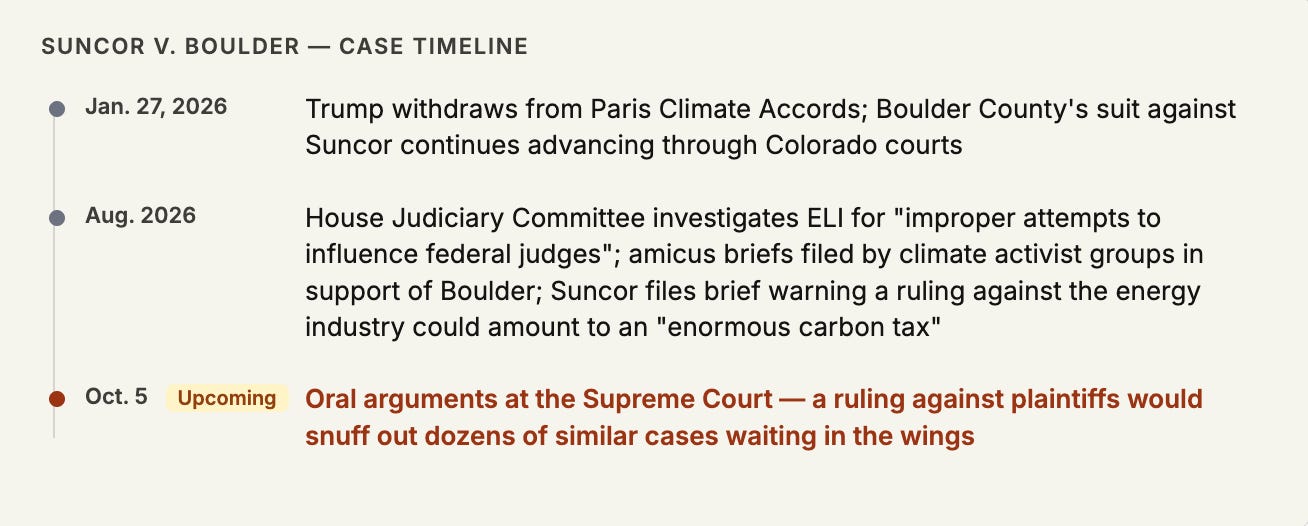
On January 27, 2026, President Donald Trump officially pulled out of the Paris Climate Accords for the second time since first taking office. President Biden made green energy a huge aspect of his administration, rejoining the accords in 2021 and promising to phase out new non-electric vehicles by 2035. Trump reversed this with an executive order on his first day back in office. But despite their electoral loss, climate activists have continued to agitate hard for their agenda, turning to the court system as their vehicle of choice.
The subversive spectre of “climate lawfare” is now on full display in the Suncor v. Boulder case pending at the Supreme Court. As Center Square describes it, one county in Colorado is effectively attempting to “impose a net zero agenda on the whole country” by way of the Colorado judiciary. Boulder County wants to hold the energy giant Suncor “liable for damages resulting from emissions that cause climate change across the globe.” In effect, they want to impose the Green New Deal through the courts.
Oral arguments in the case will be heard by the Court on October 5. Amicus briefs filed by prominent climate activist non-profits and individuals such as Colorado Attorney General Phil Weiser expose a deep web of ideologues who wish to impose liability on American energy companies, which produce yearly revenues of more than $436 million, according to Capital Research.
In a new opinion editorial in the Daily Caller, former Arizona Solicitor General O.H. Skinner exposes the dark money funding network connecting climate activist groups and the leading climate plaintiffs’ firm Sher Edling to dozens of amicus briefs filed in support of Boulder. “What is telling about these briefs is how they bear the marks of the dark money machinery behind the climate lawfare campaign,” he writes, they “help to remind us that this campaign is an ideological effort to end-run the ballot box in service of left-wing ideological dark money goals.”
Skinner writes about how briefs claiming to espouse the views of constitutional law scholars, academics, former government officials, and even Colorado cattle ranchers all “bear the marks of the dark money machinery behind the climate lawfare campaign.” Another brief led by Senator Sheldon Whitehouse attempts to cast the organizations opposing Boulder’s suit as “industry front groups.” Ironically, Sen. Whitehouse himself “ has taken campaign contributions from Sher Edling partners dating back to 2016,” Skinner writes.
A recent report from Politico suggests some former Republican EPA officials and conservative scholars have joined Boulder’s side in the Suncor case. But as Skinner points out, the former EPA officials’ brief was funded by the Clean Break Fund, a climate group dedicated to making energy companies “pay” for climate change. Politico likewise describes Prof. Jonathan Adler, who filed his own brief supporting Boulder, as a “high-profile conservative professor,” while omitting his service on the advisory committee of the Environmental Law Institute’s controversial Climate Judiciary Project, which is under investigation for feeding plaintiff-side material to judges.
This isn’t a new tactic. A recent State Armor report exposed how the Environmental Law Institute (ELI) has become “an instrument of the Chinese Communist Party’s soft power operations” by hobbling the United States with climate burdens through activist litigation without placing similar demands on Chinese energy producers. Even as China’s CO2 emissions soar, ELI lends expertise and legitimacy to Chinese regulators while supporting and encouraging domestic lawfare against the U.S. energy sector by partnering with activists and plaintiffs’ lawyers to “educate” judges on speculative “attribution science” theories. Despite its role in pushing climate lawfare, ELI is funded and supported by prestigious big law firms defending energy clients like BP and ConocoPhillips.
ELI’s influence campaigns have drawn scrutiny from lawmakers. The House Judiciary Committee investigated ELI over allegations of “improper attempts to influence federal judges” with the “underlying goal of predisposing federal and state judges in favor of plaintiffs” in climate nuisance cases.
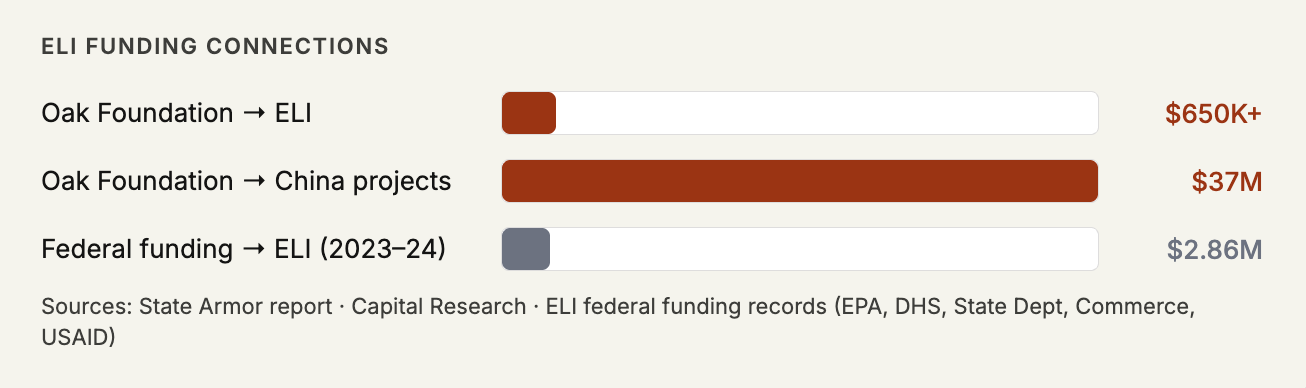
As State Armor points out, ELI relies on an extensive network of progressive foundations and activist groups funding and ideological support. This includes philanthropic connections to the Hewlett Foundation, Climate Works, Waverley Street, and the Freedom Together Foundation. Hewlett also has financial ties to Tianjin University and Peking University, entities that State Armor alleges are “integral to the CCP’s efforts to undermine the U.S. energy system.” Noted climate philanthropist, the Oak Foundation, alone has donated at least $650,000 to the ELI and $37 million to “projects located in China.” ELI also received $2.86 million in federal funding in 2023 and 2024, largely from the EPA, DHS, State Department, Commerce Department, and the Agency for International Development. ELI collects “government money to advance an agenda that undermines American supply chains and national security.”
These connections do not paint a picture of disinterested philanthropy. ELI does the bidding of activist nonprofits and foreign adversaries alike, all of whom want to see U.S. energy production curtailed. As Skinner puts it, Suncor v. Boulder alone could “lead to energy companies having to basically shut down production,” while “China won’t have to.”
The Court’s ruling in Suncor might stop this climate lawfare machine in its tracks. There are already questions as to whether Justice Elena Kagan can hear the case, due to potential conflicts of interest. And as Inside Climate News points out, a ruling against the plaintiffs would effectively snuff out dozens of other cases currently waiting in the wings.
But as Suncor warned in a Wednesday brief, a ruling against the energy industry would amount to an “enormous carbon tax, in the form of billions of dollars of damages, that could bankrupt the energy industry”; that bypasses “the political process [to] achieve sweeping policy objectives through state-law causes of action against arbitrary groups of defendants in handpicked forums.”
The prevalence of foreign and left-wing money behind the amicus briefs supporting Boulder illustrates the concerted effort to impose Green New Deal-style climate mandates through lawfare. If successful, this effort would weaken U.S. energy dependence, undermine the courts, and make energy more expensive. The Suncor case presents an opportunity to shut this effort down. As Skinner warns, climate lawfare “is not going to stop until the Supreme Court conclusively stops it.”